Best GMRS Radios for Off-Grid Camping
| Enrique Taboada
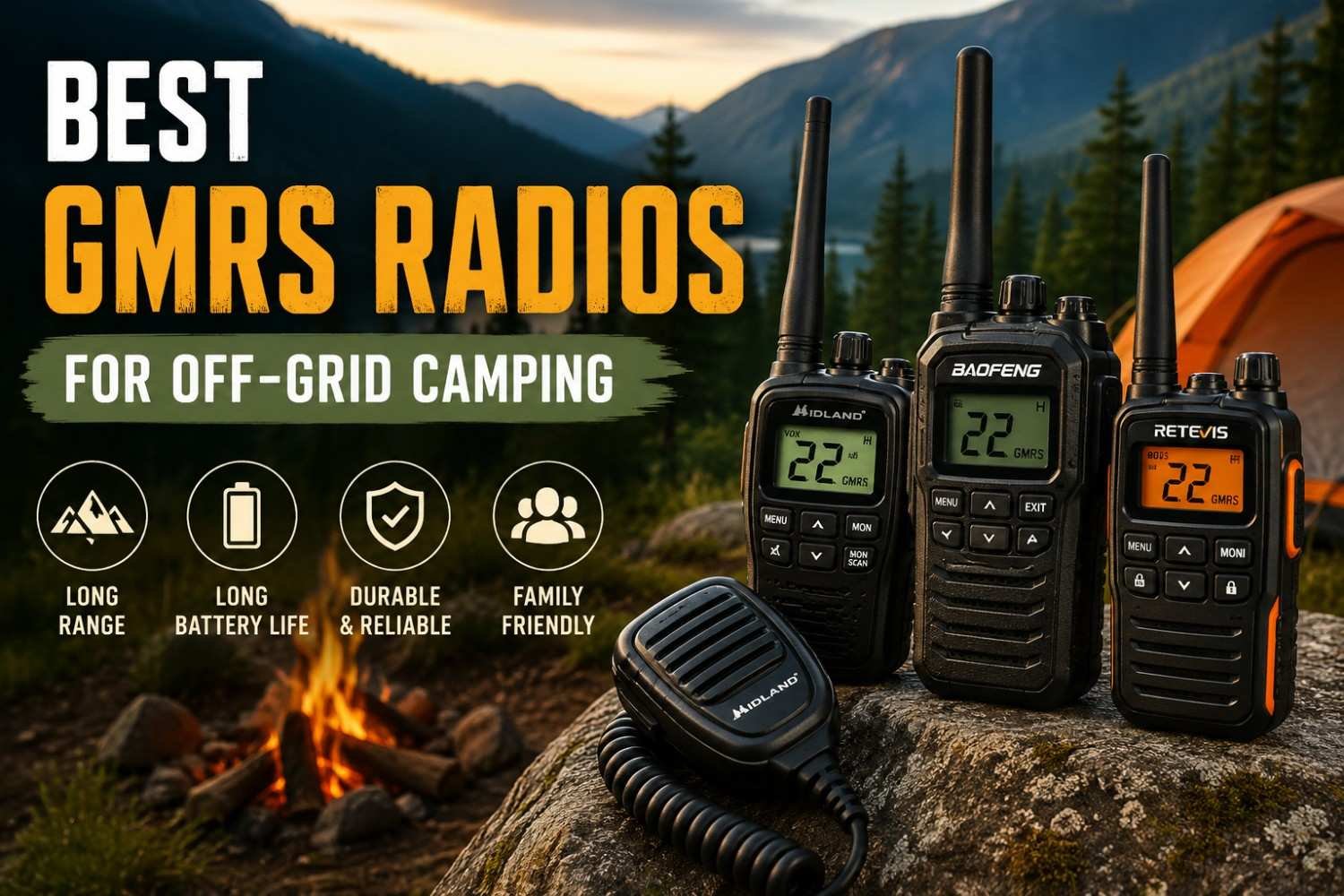
When you’re camping off-grid, your phone is just a paperweight. No signal bars, no maps, no way to check in with the people back at camp if you’ve wandered off to scout firewood or fix the trailer hitch. That’s where GMRS radios come in, and after a few seasons of testing different setups in the Florida backwoods, we’ve learned which features actually matter and which ones are just marketing noise.
Why GMRS Over Regular Walkie-Talkies
Standard FRS radios (the kind you find in big-box stores) are fine for keeping tabs on kids at a campsite, but they’re weak. Low power output, short range, and they get chewed up by trees, hills, and distance fast. GMRS radios run on higher power (up to 50 watts on some mobile units, compared to 2 watts on FRS) and can use repeaters, which means real range when you need it, not just “line of sight in an empty parking lot” range.
The tradeoff: GMRS technically requires an FCC license in the US. It’s cheap, it covers your whole family, and there’s no test involved, just a form and a fee. Worth doing if you’re serious about off-grid comms.
What We Actually Look For
Battery life that survives multiple days If a radio can’t get you through a weekend without a recharge, it’s not built for off-grid use. We prioritize radios with swappable battery packs or ones that can take standard AA batteries as backup.
A weatherproof build Camping gear gets rained on, dropped, and covered in dust. Anything without at least an IP54 rating doesn’t make our list anymore.
Repeater capability If you’re camping in hilly terrain or thick woods (which, in Florida, means dense brush more than mountains), repeater access extends your range dramatically. Not every radio supports this, so it’s worth checking before you buy.
Simple channel and privacy code setup Some radios bury basic settings in confusing menus. When you’re standing in the rain trying to reach someone back at the trailer, you don’t want to be scrolling through six submenus.
Handheld vs Mobile Units
For most camping setups, a pair of handheld GMRS radios covers the basics, campsite to trail, campsite to nearby town run, tent to tent if you’re in a larger group. But if you’re running a more permanent off-grid base (like we do with our trailer setup), a mobile unit mounted in the vehicle with an external antenna gives you a serious range upgrade over handhelds alone. We run one of each: handhelds for day-to-day, and a mobile unit as our home base radio when we’re parked somewhere for a stretch.
Antenna Upgrades Are Worth It
This is the one upgrade almost nobody thinks about first, but it makes the biggest difference. Stock antennas on most handheld GMRS radios are short and not very efficient. Swapping to a longer, higher-gain antenna is one of the cheapest ways to add real range without buying a whole new radio.
Our Take
We’re not going to pretend there’s one “best” radio that fits every setup, because it really depends on whether you’re camping solo, running a family group, or living off-grid full-time like we are. What we will say is this: don’t buy the cheapest bundle at the hardware store and expect it to work when you actually need it. Get something built for real conditions, get your license, and test it before you’re relying on it 20 miles from the nearest cell tower.
We’ll be covering our specific radio setup, antenna choice, and repeater access on the channel soon, so if comms gear is something you’re figuring out for your own off-grid trips, that’s a good one to watch for.
Enrique Taboada
I live the off-grid life out of Florida, testing solar setups, generators, and trailer mods on real trips, not in a studio. Somewhere between fixing what breaks and figuring out what works better, I started sharing it all, the wins and the mistakes. If it’s on this site, it’s because I’ve actually run it off-grid myself, dog included.
Enrique Taboada
I live the off-grid life out of Florida, testing solar setups, generators, and trailer mods on real trips, not in a studio. Somewhere between fixing what breaks and figuring out what works better, I started sharing it all, the wins and the mistakes. If it’s on this site, it’s because I’ve actually run it off-grid myself, dog included.